Erosive Wear
Ash, sand or slurry particles carried by the flow strike the surface and tear material away. Wall thinning in boiler tubes and profile loss on fan and pump parts are the most common results we see.
Symptoms
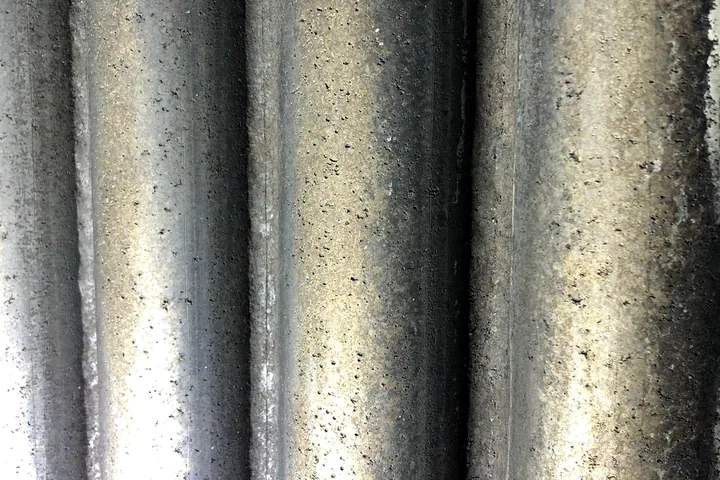
- Wavy, horseshoe or teardrop-shaped pits on surfaces facing the flow
- Flat spots and wall thinning on boiler tubes
- Thinning leading edges and unbalance on fan and pump blades
- Local perforation of elbows, cyclones and valve bodies
Typical Parts
Erosion rate is governed by particle velocity, hardness, concentration and impingement angle. At low (grazing) angles hard carbide coatings perform very well; at near-normal impact, toughness and bond strength become decisive. That is why we first examine flow direction and damage geometry.
Which Process for Which Case?
The choice depends on temperature, impingement angle and whether the work is done in the workshop or on site.
| Solution | Material System | Typical Thickness | When Is It the Right Choice? |
|---|---|---|---|
| HVOF thermal spray | WC-CoCr; Cr₃C₂-NiCr at high temperature | 150–400 µm | Fan blades, pump and valve parts; dense, low-porosity coating in the workshop |
| Arc spray (site / workshop) | Ni-Cr and FeCrBSi based wires | 0.3–1 mm | Boiler tubes and large surfaces; fast on-site application during outages |
| PTA hardfacing | NiCrBSi + WC | 1.5–5 mm | Heavy particle impact at steep angles; pump and screw parts needing thick protection |
| Coating + sealing | Metallic spray + ceramic sealer | — | Boiler surfaces where high-temperature corrosion accompanies erosion |
Values are typical ranges; the final choice is made after the part, base material and operating conditions have been seen.
Do not try to solve erosion only with a "harder" material
A step at the coating boundary on a boiler tube can disturb the flow and accelerate wear right next to it on the uncoated area. We plan coating transitions, flow direction and where losses concentrated in previous outages together.
FAQ
Can boiler tubes be coated on site?
Yes. Arc spray coatings can be applied inside the boiler during planned outages. Surface preparation (grit blasting), coating and, if required, a sealing layer are planned within the same outage.
Does coating a fan blade affect its balance?
Coating thickness is controlled, but a balance check after coating is recommended. Worn blade edges can first be rebuilt by welding.
Which coating if erosion and corrosion occur together?
Depending on temperature, Cr₃C₂-NiCr or Ni-Cr based systems are preferred; in some boiler applications they are combined with a ceramic sealer.
Let’s Talk About Your Part
Take a photo of the damaged area and send it by e-mail or WhatsApp, or call us directly. On the phone we identify the mechanism together and give a suitable process and a rough cost/lead-time indication in the same call.
- Close-up and overall photo of the damaged area
- Diameter / length or a technical drawing
- Operating conditions: temperature, medium, particles, speed